
Increase of 93% in the number of foreign people affiliated to the Social Security with authorization for rooting in the last year
30/09/2026
Permanent Observatory on Immigration
Increase of 93% in the number of foreign people affiliated to the Social Security with authorization for rooting in the last year
Topics:

• The Permanent Observatory of Immigration (OPI) collects a total of 346,374 people with residence authorization by arraigo affiliated to the Social Security in June 2026
• More than 65% of the total number of people aged 16 and over with residence authorization by rooting are incorporated into the labor market, the highest percentage of affiliation of this group since 2023
• Elma Saiz, Minister of Inclusion, Social Security and Migration: “Rooting is a valuable tool that is allowing us to connect the needs of the labor market with people who have already accredited stable ties with our society.”
• According to the IPO, about 543,000 people had a rooting authorization in force at the end of the first half of the year, 54.7% compared to June 2025
Share on social networks:
The Permanent Observatory of Immigration (OPI), attached to the Secretary of State for Migration, collects a total of 346,374 people affiliated to the Social Security in its latest statistic on people with residence authorization by arraigo, on June 30, 2026.
The total number of people entering the labour market at the reference date represents 65% of this group of people of working age, that is, people aged 16 or over. This is the highest percentage of affiliation of this group since September 2023, according to the IPO.
In the comparison with June of the previous year, the data also reflects an increase of 54.7%, which highlights the effectiveness of this figure of our legal system as a means of access to the labor market.
Regarding the type of rooting, 43% (148,445) of these affiliated persons have a socio-occupational rooting authorization as of June 30, 2026, followed by those with family roots (37%; 129,521).
For the Minister of Inclusion, Social Security and Migration, Elma Saiz, “the data support that access to a regular administrative situation is directly linked to the improvement of professional opportunities and the growth of our labor market.”
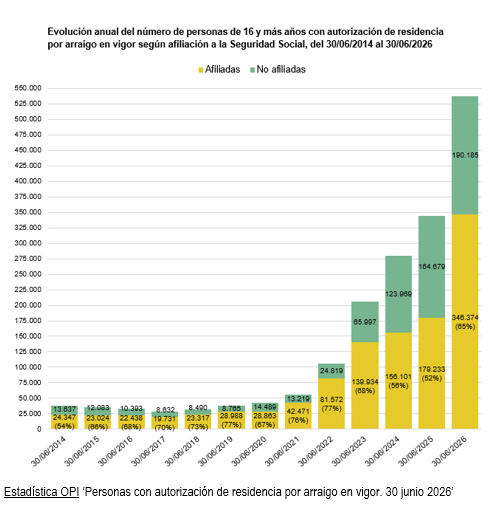
The update of the statistics of the Permanent Observatory of Immigration includes a total of 542,953 foreign people with a residence authorization for rooting in force on June 30, 2026, 54.7% more than on the same date last year. Among these people, family rooting is the predominant since it accounts for 45% of the total residence permits due to rooting on the reference date.
The percentage of affiliation increases in all provinces compared to the previous year and 45% of the affiliated persons are women
The statistics of the IPO show that Huelva (81%) and Soria (76%) are the provinces with the highest percentage of people incorporated into the labor market on June 30, 2026 thanks to a residence authorization for rooting. On the other hand, in comparison with June 2025, all provinces recorded an increase in the percentage of affiliation to the Social Security of this group. The largest increases are observed in Cádiz, Almería, Málaga and Segovia, with increases of between 18 and 21 percentage points.
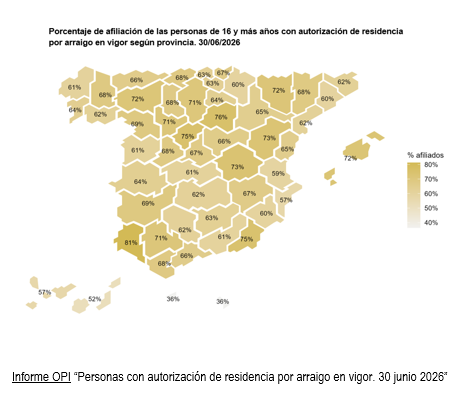
With regard to the classification by gender, the OPI highlights that women represent 45% (154,507) of the people affiliated to the Social Security with a residence permit for rooting in force on June 30, 2026, compared to 55% of men (191,867), a difference of 10 percentage points.
In both cases, the figures have increased significantly in the last year: 93.7% (92,805 more people) for men and 92.7% (74,336 more people) for women.
Colombia, Morocco and Peru are the nationalities with the highest number of people aged 16 and over who are affiliated to the Social Security and who have a residence permit due to its entry into force. As of June 30, 2026, they represent, respectively, 28% (98,444 people), 15% (53,239) and 10% (32,975) of the total.
As for the main sections of activity, the hotel industry occupies the first place, with 19% of the total number of affiliated persons (64,490). Then there are construction (14 per cent; 49,777), household activities as employers of domestic personnel and producers of goods and services for their own use (13 per cent; 43,712), administrative activities and ancillary services (12 per cent; 41,239) and wholesale and retail trade (11 per cent; 37,478).
Family rooting is the majority modality, with 45% of the total number of people who have a residence permit for rooting.
The data of the Permanent Observatory of Immigration reflected a total of 542,953 people with residence authorization for roots in force in June 2026, 54.7% more than a year ago.
The types of rooting have evolved in the last year influenced by the new regulation of foreigners, the creation of three new types of rooting and the consequent loss of validity of some others. Thus, as of June 30, 2026, 45% (244,293) of the people with authorization for rooting presented the family type and 33% (181,001) had authorization for the new socio-labor rooting, thus consolidating itself as the new alternative of rooting.
The Observatory also highlights that the quarterly variation reaches the maximum of the whole series, 28.4%, just one year after the entry into force of the regulation on foreigners approved by Royal Decree 1155/2024, of 19 November.
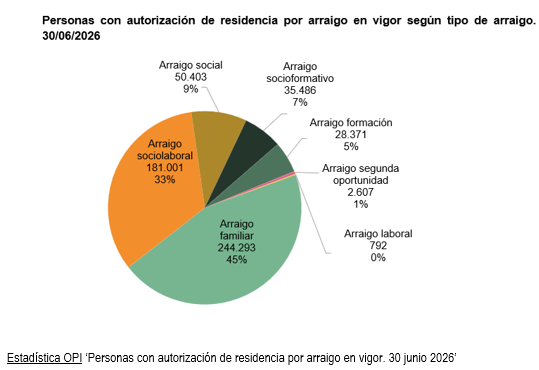
With regard to the countries of origin, Colombia is the most frequent country of nationality among people with residence authorization for rooting in force on June 30, 2026, representing 27% (144,808 people) of the total. Morocco is the second, with 85,313 people and representing 16% of the total; followed by Peru, with 52,000 people, 10% of the total.
71% of young people discharged between 18 and 23 years of age enter the labour market
The Permanent Observatory of Immigration also updates the statistic ‘Unaccompanied minors and extutelated youths, from 16 to 23 years, with residence authorization in force’ which includes a total of 22,395 people as of June 30, 2026.
81% are young ex-guardians aged between 18 and 23 years old. The remaining 19% are under 16 and 17 years of age.
The data of the group as a whole show that 61% of people are incorporated into the labor market as of June 30, 2026, a percentage that increases to 71% in young people from 18 to 23 years old ex-tutelada.
Among unaccompanied minors aged 16 and 17, the volume of employment is lower because they are still in the protection system and are often involved in training activities that promote their employability in the future. Even so, the percentage of affiliation grew 2 points, from 15% to 17%, in the last year.
While half of the 16 and 17 year-olds work in the hospitality industry, extutelated young people between the ages of 18 and 23 are more evenly distributed among different sectors. 29% work in hospitality, 16% in administrative activities and auxiliary services and 13% in construction. Together, these three activities account for 58 per cent of the total.
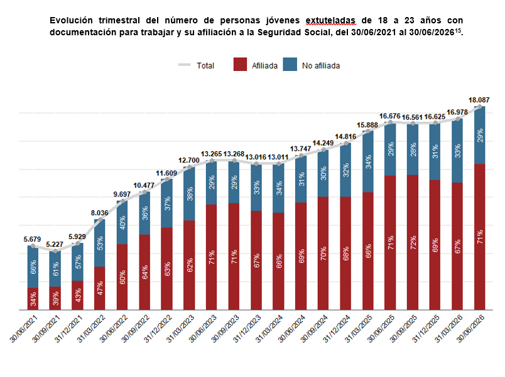
With regard to the type of contract for affiliated minors/extutelates, full-time openness is the modality that has increased the most in recent years. As of June 30, 2023, 31% had this type of contract. Three years later, as of June 30, 2026, this percentage had risen to 38%.
The demographic profile of the Observatory shows that 47% of unaccompanied minors and extutelated youths have Moroccan nationality, 14% are nationals of the Gambia (14%), followed by Algeria (13%) and Senegal (12%).
In the past year, the IPO has seen a decline in the number of nationals from Morocco, Pakistan, Ghana and Nigeria. The rest of the main nationalities show an opposite trend, increasing above the total, highlighting Mali, with an annual rate of 125.0% and Senegal, with 79.3%.
______________________________________
Permanent Observatory on Immigration (OPI)
https://www.inclusion.gob.es/web/opi
“Personas con autorización de residencia por arraigo en vigor”
Ver Informe
https://www.inclusion.gob.es/web/opi/estadisticas/catalogo/stock_arraigo?tab=ultimos-datos
View Infographic
https://www.inclusion.gob.es/fr/web/opi/estadisticas/productos_servicios/infografias/stock_arraigo
“Unaccompanied minors and extutelated youths, from 16 to 23 years old, with valid residence authorization”
See Report
https://www.inclusion.gob.es/documents/d/opi/nota_menores
View Infographic
https://www.inclusion.gob.es/fr/web/opi/estadisticas/productos_servicios/infografias/stock_menores